


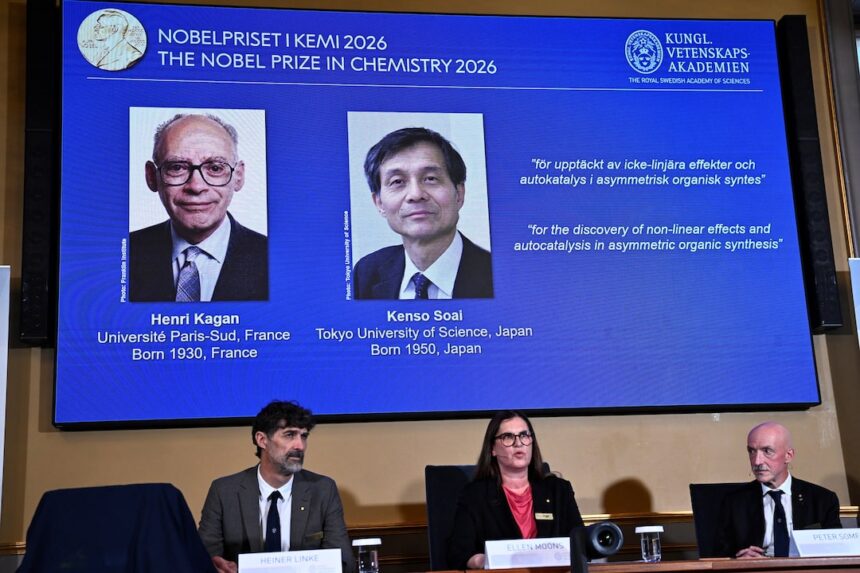
The 2026 Nobel Prize in chemistry has been awarded to 95-year-old Henri B. Kagan and Kenso Soai for groundbreaking work in the field of asymmetric chemistry – unraveling the mystery of how molecules exist in non-identical mirror images of each other.
The chemistry prize was announced on Wednesday at the Royal Swedish Academy of Sciences in Stockholm.
Their work has “been revolutionary for chemists who develop reactions for the manufacture of pharmaceuticals, flavours, scents and new materials,” the Nobel committee said in a statement.
David Pendlebury, head of research analysis at Clarivate’s Institute for Scientific Information, said the work opened new directions for chemists exploring how molecular complexity arose.
“This year’s Nobel Prize in Chemistry recognises discoveries whose influence has unfolded over decades,” he said.
“The award is a reminder that transformative advances often emerge from sustained, curiosity-driven research, and that the significance of fundamental scientific discoveries may take many years, or even decades, to be fully appreciated,” he added.
Mr. Kagan, 95, is French and a professor emeritus at Université Paris-Sud in France.
Mr. Soai was born in Hiroshima, Japan, and is a professor emeritus at the University of Science in Japan.