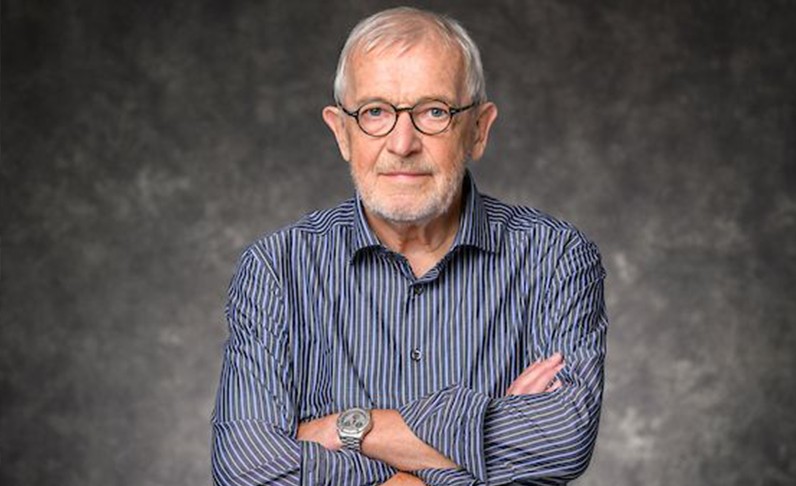
The 2026 Nobel Prize in physics has been awarded to Francis Halzen, a pioneering Belgian astrophysicist whose work developing a massive observatory in Antarctica to detect “ghostly” cosmic particles laid the foundations for an “entirely new type of astronomy.”
The physics prize was announced on Tuesday, October 6, at the Royal Swedish Academy of Sciences in Stockholm. “Francis Halzen has led an international team of researchers and engineers who have provided us with a fantastic instrument,” said Nobel committee chair, Mark Pearce, in a statement. “His tenacity and scientific vision has paved the way for a new kind of astronomy.”
Halzen told the Nobel news conference by phone from Italy that it was a “great surprise” and “pleasure” to win the award. “When we started this project, everybody realised this was maybe a good idea but very few thought it would work, including myself,” he said. “So this was kind of an adventure where success wasn’t guaranteed.”
Halzen, a professor based at the University of Wisconsin–Madison, first presented plans for this observatory – now called the IceCube Neutrino Observatory – in 1988, envisioning a vast apparatus in the Antarctic ice that could capture particles known as neutrinos.
The observatory harnesses a key property of neutrinos; namely that they produce a flash of light when colliding with an atomic nucleus which could be tracked by sensors embedded in clear, glacial ice.
Arriving at Earth from the far reaches of the cosmos, neutrinos are often called “ghostly” because they are extremely volatile, or vaporous, and can go through any kind of matter without changing. They have almost no mass, and no electrical charge. They can travel through the most extreme environments, like stars, planets and entire galaxies, and remain the same.
“It’s been a while since the Nobel Prize has gone to a single individual and that points to the uniqueness of his vision,” said Richard Fitzgerald, editor-in-chief of Physics Today, which is published by the American Institute of Physics.
“It took a team of hundreds of people to build it, but it all started with one person,” he added.