

By Olatunbosun Obafemi
The Church of Nigeria, Anglican Communion, has issued new guidelines restricting politicians and public officials from addressing congregations from the pulpit during services and official programmes.
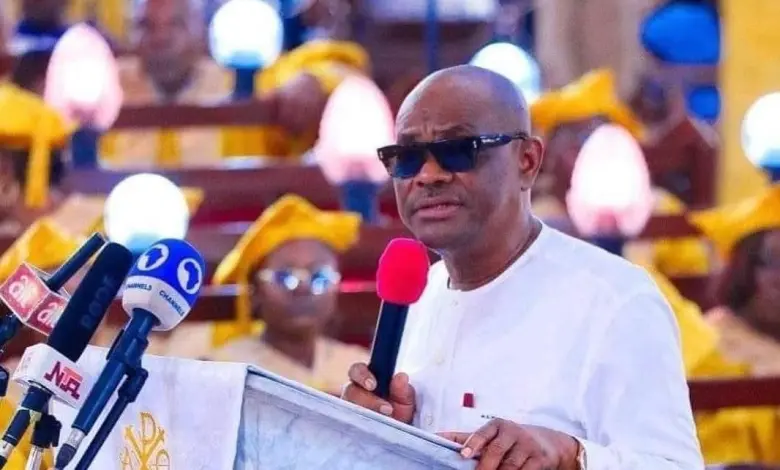
This move comes amid growing public criticism following a recent incident involving the Minister of the Federal Capital Territory (FCT), Nyesom Wike, who used the pulpit during a thanksgiving service in Abuja to launch a politically charged tirade.
Wike, who was speaking at St James’ Anglican Church in Asokoro to celebrate the completion of infrastructure projects in the FCT, deviated from the occasion to criticise the church’s political leanings in the 2023 general elections. He also launched a personal attack on Labour Party presidential candidate Peter Obi, declaring that he would “never be president,” and made pointed remarks about the state of the nation prior to President Bola Tinubu’s assumption of office.
The Anglican Church’s leadership responded swiftly. In a memo signed by the Primate of the Church, Most Rev. Henry Ndukuba, and circulated on Saturday, the church said the decision was reached during a recent episcopal consultation held in the Diocese of Nike, Enugu State.
According to the memo, the new guidelines are aimed at preserving the sanctity and neutrality of Christian worship and curbing the increasing use of church platforms for political messaging. It stressed that while all individuals, including government officials, are welcome to attend services, the pulpit must not be used for partisan speeches or propaganda.
“The Church remains a place of worship, unity, and spiritual guidance,” the Primate stated. “We must ensure that it is free from the distractions and divisions of politics.”
Under the new rules, politicians and other visiting dignitaries will no longer be allowed to speak from the church’s lectern or pulpit, both of which are consecrated for the reading of Scripture and the preaching of God’s word by ordained clergy. Any guest expected to address the congregation must first consult with church leadership to ensure their remarks are in line with the church’s spiritual focus and non-partisan stance.
The memo also instructs church leaders to avoid eulogising public figures in a way that could compromise the church’s reputation or suggest political bias. Clergy are further cautioned against making statements that could be perceived as politically motivated.
Citing past instances, the church noted that the growing politicisation of religious spaces poses a threat to the unity and integrity of the Christian community. “Our mission,” Ndukuba said, “is to be the light of the world and the salt of the earth. We must not allow the sacredness of our worship to be diluted by political interests.”
He reaffirmed the church’s commitment to engaging with political authorities on issues affecting the nation, but emphasised that its primary role remains spiritual. “We will continue to pray for our leaders and provide moral guidance, but we draw a firm line against any form of partisanship within the sanctuary.”
As of the time of this report, neither the Minister of the FCT nor the Presidency had issued a response to the Anglican Communion’s directive.