

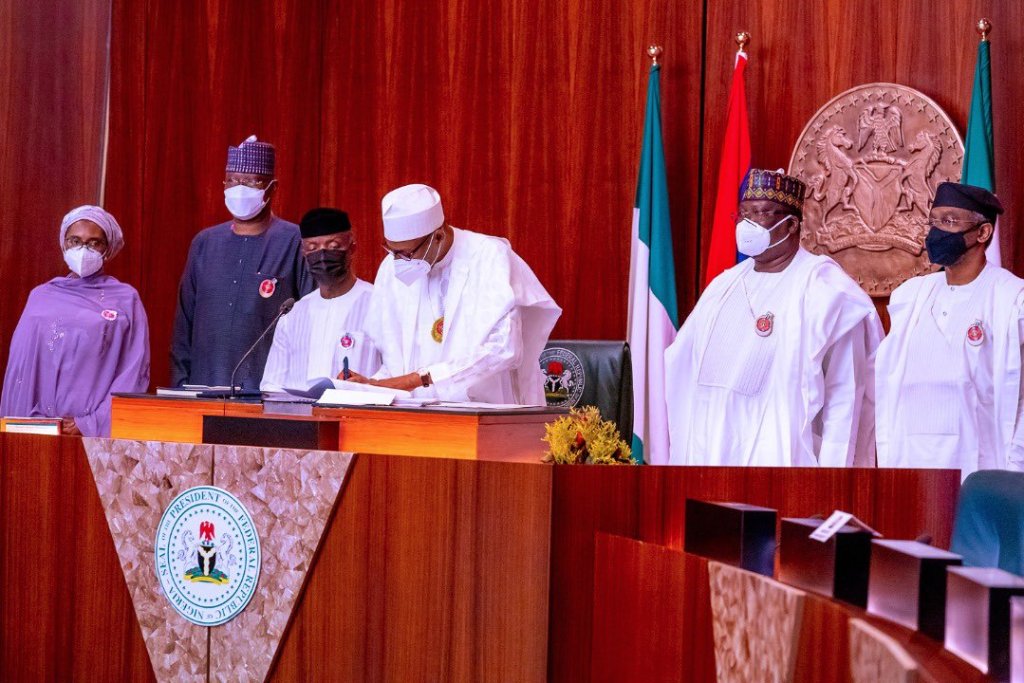
On Thursday, 31st December 2020, President Muhammadu Buhari signed the N13.6 trillion 2021 appropriation act approved by the National Assembly into law. Earlier in October, while presenting the budget to the legislatures, the president said the 2021 appropriation bill was designed to further deliver on the goals of the Federal Government’s Economic Sustainability Plan.
The plan, he said, provides a clear road map for post-Coronavirus economic recovery as a transitional plan to take the country from the Economic Recovery and Growth Plan (2017 – 2020) to the successor Medium Term National Development Plan (2021 – 2025).
In its expectation, the Federal government said the budget will accelerate the pace of Nigeria’s economic recovery, encourage and enhance competitiveness, promote economic diversification and ensure social inclusion.
Although the government had proposed N13.8 trillion out of which N7.89 trillion is the forecasted revenue to be generated. With a deficit of N5.02 trillion, financing the deficit would be through borrowing of a total of N4.28 trillion.
Of this new borrowing, N205.15 billion would be from privatization proceeds and N709.69 billion from drawdowns on multilateral and bilateral loans secured for specific project and programmes. The government put the oil benchmark on $40 per barrel with a daily production output at 1.86 million bpd and an exchange rate of N379 to $1.
President Buhari had in his speech delivered at the national assembly while presenting the budget explained that the current economic recession occasioned by the global economic downturn is fashioned into the 2021 budget.
IMPACT NEWS holds that while the President and his handlers may be optimistic about the possible implementation of the budget based on its projections, the reality on ground leaves very little for Nigerians to expect from the 2021 budget.
With unemployment rate of over 25%, and a shrinking revenue generation, the Federal Government is faced with the challenge of funding the budget, thus it would resolve to more borrowing to meet its obligation. This again we are worried that the country continues its free fall into a heavy debt burden.
Like the previous budgets, the security again gets the lion share. IMPACT NEWS is less enthusiastic on justification of the appropriation for the sector with the level of insecurity all over the country. It should be noted that the country is at the verge of food shortage if nothing concrete is done to tackle the challenge.
The unceasing clash between farmers and herders, the terror acts of Boko Haram, banditry and kidnapping will pose a serious challenge to food production economic sustainability and Foreign Direct Investment (FDI) in 2021.
There is therefore the need for the government to effect reality into the budget in order to provide a cushion for Nigerians to sail out of the current economic recession.