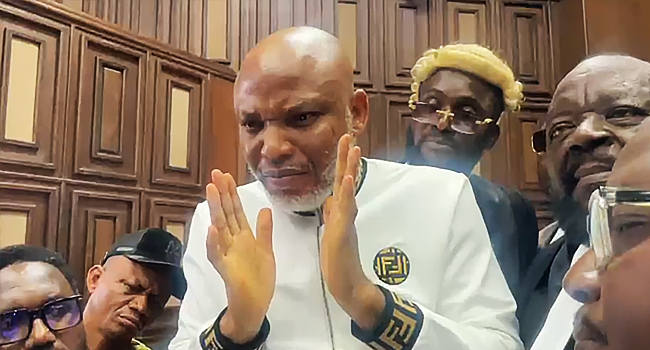
The second prosecution witness in the ongoing trial of Indigenous People of Biafra (IPOB) leader, Nnamdi Kanu, told the Federal High Court in Abuja on Wednesday that the Eastern Security Network (ESN), established by Kanu, operates without any legal basis, in contrast to the South-West’s Amotekun Corps which is supported by state legislation.
Testifying under the codename “BBB,” the witness, a senior official of the Department of State Services (DSS), made this assertion during re-examination by the lead prosecution counsel, Adegboyega Awomolo (SAN). Awomolo had asked the witness to compare ESN with Amotekun, the regional security outfit created by the South-West governors.
According to the witness, Amotekun was formally established through laws passed by the Houses of Assembly in the six South-West states, while ESN, despite engaging in paramilitary activities, was never authorised by any state or federal law.
He added that although the DSS had, at one time, advocated for community-based policing to bolster national security, it had always emphasized that such initiatives must be conducted with the oversight and approval of statutory security agencies.
Earlier in the day’s proceedings, the defence team, led by Paul Erokoro (SAN), presented three video recordings contained on a flash drive. The court admitted the videos into evidence, and they were subsequently played in open session.
In the first video, DSS Director-General Yusuf Bichi was seen addressing a public gathering, where he spoke about the need for communities to establish a “first line of defence” in the face of growing insecurity. Bichi acknowledged the limitations of national security deployments and said communities should be empowered to protect themselves — but only under the guidance of recognised security bodies.
“The practical approach to mobilising people is to get everyone involved,” Bichi was heard saying. “We have to allow some level of armament for the communities to rise and defend themselves first, but under the guidance and approval of security agencies.”
When asked by Erokoro whether the DSS chief’s comments amounted to a call for the arming of civilians, the witness responded that the DG had been clear that any such community-led defence must be carried out with official sanction.
The second video played in court featured retired Defence Minister General Theophilus Danjuma. In his address, Danjuma alleged that some elements within the armed forces were not acting neutrally in the face of ongoing violence across the country. When Erokoro asked the witness to comment on Danjuma’s assertion, he declined, saying any clarification should be sought from Danjuma directly.
The third video showed Governor Hope Uzodinma of Imo State lamenting the spate of killings in Orlu and attributing the violence to unnamed political actors. Erokoro questioned whether this contradicted the DSS’ position that IPOB members were responsible for the killings. The witness stood by the DSS’ findings.
“Our investigation revealed those who were killed by suspected IPOB members, and we mentioned their names. The governor did not mention any names of the people he said were killed,” he said.
The witness also confirmed that IPOB had been proscribed as a terrorist organisation by a court order, and asserted that Kanu remained a member of the group both before and after its proscription.
In a shift from the focus on IPOB, Erokoro asked the witness about the nationwide #EndSARS protests of 2020. The witness acknowledged that the protests were driven by demands to disband the Special Anti-Robbery Squad (SARS) and that both state governments and the National Human Rights Commission had set up panels of enquiry to investigate the incidents.
He confirmed that the Lagos State Judicial Panel’s report on the protests neither identified IPOB as a participant nor classified the demonstrations as terrorist activity. The defence then tendered the panel’s report, which was admitted into evidence by the court.
Before adjourning, Justice James Omotosho directed the prosecution to conclude its case within six days, while allocating nine days to the defence to present its arguments. With both parties in agreement, the court scheduled further hearings for May 28 and 29, and June 6, 16, 18, and 19.
The trial of Nnamdi Kanu, which has drawn national and international attention, continues against the backdrop of sensitive debates over self-determination, regional security, and the limits of lawful activism.