

By Nchetachi Chukwuajah
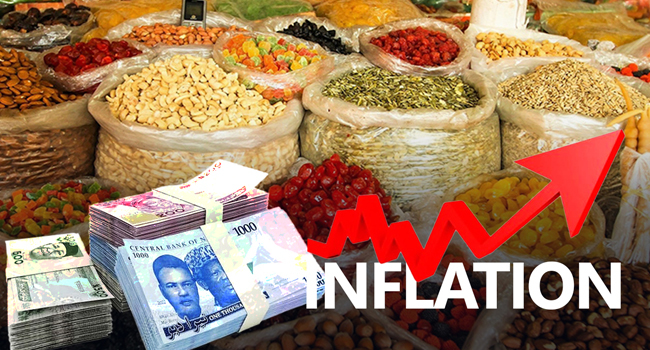
The rate of increase in the prices of food items has pushed Nigeria’s inflation rate to rise for the third consecutive month to 15.93 percent in May 2026.
This was contained in the latest Consumer Price Index (CPI) report released by the National Bureau of Statistics (NBS) on Monday, June 15.
The CPI report showed that inflation increased from 15.69 percent in April to 15.93 percent in May, extending an upward inflationary trend that began in March after inflation fell slightly to 15.06 percent in February 2026.
The report showed that the Consumer Price Index increased to 140.7 in May from 138.3 in April, representing a 2.4-point increase in the general price level.
The May inflation rate indicated that food prices continued to pressure household budgets despite a slowdown in the pace of monthly price increases.
“In May 2026, the headline inflation rate on a month-on-month basis was 1.75 percent, which was 0.39 percent lower than the rate recorded in April 2026 (2.13 percent).
“This means that in May 2026, the rate of increase in the average price level was lower than the rate of increase in the average price level in April 2026,” the report stated.
Although the month-on-month inflation rate moderated, the annual inflation rate maintained an upward trajectory, rising from 15.38 percent in March to 15.69 percent in April before reaching 15.93 percent in May.
“On a year-on-year basis, the headline inflation rate rose to 15.93 percent, up from 15.69 percent in April 2026 and down from 26.06 percent in the same month of the preceding year (May 2025). Looking at the movement, the May 2026 headline inflation rate showed an increase of 0.24 percent compared to the April 2026 headline inflation rate,” the report read.
However, the May 2026 figure remained substantially below the 26.06 per cent recorded in May 2025, highlighting the significant easing in inflationary pressures compared with a year earlier. The NBS noted that the May inflation rate was 0.24 percentage points higher than the 15.69 percent recorded in April.
An analysis of the inflation basket showed that food and non-alcoholic beverages remained the largest contributor to headline inflation, accounting for 6.38 percentage points of the annual inflation rate.
Restaurants and accommodation services contributed 2.06 percentage points, and transport accounted for 1.70 percentage points, while housing, water, electricity, gas, and other fuels contributed 1.34 percentage points.
Education services contributed 0.99 percentage points to headline inflation, followed by health at 0.97 percentage points and clothing and footwear at 0.80 percentage points. Information and communication, as well as personal care and miscellaneous goods and services, each contributed 0.52 percentage points.
The report further showed that average inflation for the 12 months ending May 2026 stood at 18.36 percent, compared with 30.57 percent recorded in the corresponding period of 2025.
The NBS reported that food inflation stood at 16.96 percent year-on-year in May, compared with 24.55 percent in the corresponding month of 2025. On a month-on-month basis, food inflation eased to 2.98 percent from 3.63 percent recorded in April.
According to the bureau, the increase in food prices was driven by the rising cost of staple items, including onions, maize grains, melon, water yam, cassava flour, crayfish, fresh pepper, tomatoes, wheat grain, cassava tubers, yam tubers, sweet potatoes, ginger, plantain, and cowpea.
“The average annual rate of food inflation for the twelve months ending May 2026 over the previous twelve-month average was 16.99 percent, which was 16.22 percentage points lower compared with the average annual rate of change recorded in May 2025 (33.21 percent),” the report stated.
According to the NBS, core inflation, which excludes volatile agricultural produce and energy prices, stood at 16.82 percent year-on-year in May, compared with 24.92 percent in May 2025.
The report showed that on a month-on-month basis, however, core inflation rose significantly to 1.94 percent from 1.03 percent in April.
Urban inflation stood at 16.07 percent year-on-year in May, while monthly urban inflation rose to 1.99 percent from 1.86 percent in April.
The 12-month average urban inflation rate stood at 18.27 percent, significantly lower than the 32.55 percent recorded in the corresponding month of 2025.
The NBS noted that rural inflation stood at 15.60 percent year-on-year. Monthly rural inflation slowed to 1.17 percent from 2.80 percent in April, while the 12-month average rural inflation rate eased to 18.19 percent from 28.36 percent recorded in May 2025.
Further analysis of the report showed that services inflation remained high at 17.92 percent year-on-year and 2.84 percent month-on-month.
Imported food inflation stood at 14.60 percent year-on-year and 2.28 percent month-on-month, while goods inflation was recorded at 6.62 percent year-on-year and 0.73 percent month-on-month. Energy inflation stood at 5.73 percent year-on-year and 0.72 percent month-on-month.
A state-level analysis of the report showed that Yobe recorded the highest headline inflation rate on a year-on-year basis at 24.94 percent, followed by Anambra at 23.29 percent and Sokoto at 22.60 percent.
On the other hand, Niger recorded the lowest annual inflation rate at 3.07 percent, followed by Plateau at 7.10 percent and Edo at 7.73 percent.
On a month-on-month basis, Benue recorded the highest increase in headline inflation at 8.23 percent, followed by Bayelsa at 7.62 percent and Borno at 7.29 percent.
The lowest increase in headline inflation month-on-month was recorded in Niger at 4.55 percent, followed by Zamfara at 3.36 percent and Taraba at 2.67 percent.
For food inflation, Adamawa recorded the highest annual food inflation rate at 29.62 percent, followed by Kwara at 28.47 percent, and Rivers at 28.40 percent.
Borno recorded the lowest annual food inflation rate of 6.53 percent, while Taraba and Bayelsa recorded the slowest increases at 1.13 percent and 5.99 percent, respectively.
On a month-on-month basis, Bauchi recorded the highest food inflation rate at 7.73 percent, followed by Ogun at 6.86 percent, and Jigawa at 6.69 percent. Niger, Katsina, and Gombe recorded food price declines of 3.54 percent, 3.48 percent, and 2.22 percent, respectively.