Odesola JF., PhD
There are moments in the life of a democracy when an election becomes much more than a contest between political parties. It becomes a test of the strength of institutions, the maturity of political leaders, the professionalism of security agencies and, most importantly, the power of ordinary citizens to decide who should govern them.
The 2026 Osun State governorship election is one of those moments.
As Nigeria prepares for the 2027 general elections, Osun deserves serious reflection – not simply because of who won or lost, but because of what the election says about democracy, political power and the relationship between the people and those who seek to govern them.
The election, held on August 15, 2026, was fiercely contested. Fifteen political parties participated, and the contest eventually became a close battle between incumbent Governor Ademola Adeleke of the Accord Party and Bola Oyebamiji of the All Progressives Congress. The Independent National Electoral Commission (INEC) declared Adeleke the winner with 511,067 votes against Oyebamiji’s 444,815 votes. Adeleke won 19 of the state’s 30 local government areas, while Oyebamiji won 11.
Those figures tell us who won the election.
But they do not tell the whole story.
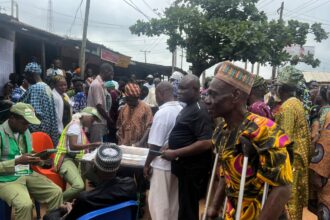
The deeper story is about the people who woke up that morning, walked to polling stations, stood in queues, waited under the sun and eventually placed their ballots in the box. Behind every vote was a human being—a mother thinking about her children, a young person worried about employment, a farmer thinking about roads, a trader concerned about the economy and an elderly citizen hoping that government would make life a little easier.
That is why elections matter.
The People Must Never Become Political Spectators
Democracy is not a favour politicians grant to citizens. It is the constitutional right of citizens to choose their leaders.
Political parties may have money. Candidates may have powerful supporters. Governments may control institutions. Security agencies may have uniforms, vehicles and weapons.
But none of these should replace the ballot.
The ultimate legitimacy of democratic government comes from the people.
This is one of the most important lessons Nigeria should take from Osun as 2027 approaches.
The lesson is not that one political party has discovered a permanent formula for winning elections. Neither should anybody conclude that incumbents will always win or that opposition parties will automatically take power.
Democracy does not work that way.
The people can change governments.
The people can retain governments.
The people can reject political calculations.
And sometimes, the people can completely surprise political establishments.
That is the beauty – and sometimes the discomfort – of democracy.
Hunger Can Influence Politics, But It Must Not Buy the Conscience of the People
Nigeria must also have an honest conversation about poverty.
A hungry person is vulnerable.
A young man without employment can easily be recruited into political violence. A struggling family can be tempted by a small cash payment. Someone who has spent months worrying about food may find it difficult to reject money offered during an election.
This is where political leaders must understand that poverty should never become a weapon against democracy.
An election must not become an auction in which the highest bidder buys the future of the poorest citizen.
A bag of rice may feed a family for some days or weeks. A small amount of money may solve an immediate problem. But the government elected for the next four years will influence much bigger things – education, healthcare, roads, electricity, employment, security and the economic future of millions.
So the Nigerian voter should ask a different question in 2027:
“What will this candidate do for my children tomorrow?”
That question is more important than:
“What did this candidate give me today?”
Political gifts disappear.
Political decisions can affect generations.
Uniforms Must Protect Democracy, Not Frighten Voters
Security agencies have an important responsibility during elections. Their job is to protect voters, electoral officers, political parties, election materials and the integrity of the process.
They must never become instruments of intimidation.
Ahead of the Osun election, the Nigeria Police Force warned that violence, intimidation, vote-buying and ballot snatching would not be tolerated. That is the right principle, and it should become even stronger as Nigeria approaches 2027.
A police officer should make a voter feel safe.
A soldier should make a citizen feel protected.
A security official should be seen as a defender of the Constitution, not as an extension of any political party.
Imagine an elderly woman arriving at a polling station and seeing heavily armed security personnel surrounding the area. If their presence communicates protection, she will feel confident. If it communicates fear, democracy has already suffered—even before she casts her vote.
Security must therefore be firm against criminals but gentle toward innocent citizens exercising their constitutional rights.
The World Has Seen the Power of the People
Nigeria is not alone in learning that ordinary citizens can reshape political history.
Look at South Africa in 1994. After decades of apartheid, millions of South Africans participated in the country’s first democratic election. Nearly 20 million people queued to vote, and Nelson Mandela became the country’s first democratically elected president.
It was more than an election.
It was a national turning point.
People who had been denied political rights finally stood in line to exercise them. The ballot became an instrument through which an unjust political order was peacefully transformed.
Kenya provides another important example.
In 2002, after Daniel arap Moi’s long presidency, Mwai Kibaki defeated the ruling party’s candidate and power changed hands peacefully. The transition demonstrated that a political system can experience significant change without the country descending into chaos.
Ghana’s 2024 election provides another lesson in political maturity. Opposition candidate John Mahama won the presidential election, while his principal rival, Mahamudu Bawumia, conceded before the Electoral Commission formally announced the final result. That gesture helped reduce tension and demonstrated how responsible political behaviour can protect national stability.
The Philippines offers a different but equally important lesson. The 1986 People Power movement demonstrated the extraordinary strength of citizens mobilising for political change, while also showing that democratic movements depend heavily on how institutions and security forces respond.
The broader lesson from these experiences is simple:
Democracy requires courageous citizens and institutions strong enough to respect their choices.
Osun Is a Warning to Nigeria’s Political Class
Nigeria’s 2027 elections are scheduled for January 16, 2027, for the presidential and National Assembly elections, while governorship and State House of Assembly elections are scheduled for February 6, 2027.
There is therefore no excuse for being unprepared.
The issues confronting the country are already obvious: economic hardship, insecurity, declining confidence in political institutions, electoral offences, voter participation and the neutrality of security agencies.
Osun should not merely become something politicians discuss after an election. Its lessons should be converted into practical action.
INEC must be independent, efficient and transparent.
Security agencies must remain professional and politically neutral.
Political parties must reject violence and intimidation.
Candidates must learn to accept legitimate outcomes.
Courts must remain impartial.
Citizens must refuse to sell their votes.
Civil society organisations must continue monitoring elections.
The media must report responsibly.
And voters must understand that their Permanent Voter’s Card is not merely a plastic card.
It represents their voice.
It represents their opportunity to say, peacefully:
“This is who I want to govern me.”
2027 Must Be About Nigeria, Not Fear
As 2027 approaches, Nigerians will hear many promises.
Some politicians will appeal to ethnicity.
Some will appeal to religion.
Some will distribute money.
Some will use propaganda.
Some may try to frighten voters.
But citizens must remember something very important:
Fear is temporary. The consequences of bad government can last for years.
Therefore, nobody should surrender his or her democratic rights because of intimidation.
Nobody should allow poverty to permanently silence their conscience.
Nobody should allow party loyalty to destroy independent judgment.
And nobody should allow ethnic or religious sentiment to become a substitute for competence, character, accountability and good governance.
Political parties are vehicles.
They are not families.
Political candidates are servants seeking public office.
They are not owners of the country.
The country belongs to the people.
Let the Ballot Speak
The Osun experience should therefore be viewed beyond party colours.
It should be viewed as a reminder that democracy works best when citizens are allowed to make choices freely, institutions remain credible, security agencies remain neutral and political actors respect the rules.
Nigeria does not need another election that leaves communities divided and families mourning.
Nigeria needs elections that produce leaders with legitimacy.
We should approach 2027 not with violence, but with courage.
Not with hatred, but with wisdom.
Not with thuggery, but with civic responsibility.
Not with intimidation, but with constitutional confidence.
The message to every political actor should be simple:
You may campaign.
You may persuade.
You may mobilise.
You may contest.
You may seek the people’s votes.
But when the people have spoken through a credible election, you must listen.
And the message to every Nigerian voter should be even stronger:
Do not surrender your future to fear.
Your vote may look small in your hand, but collectively, millions of votes can change the direction of a nation.
Osun is therefore more than an election.
It is a case study.
It is a warning.
It is an encouragement.
And as Nigeria moves toward 2027, one message should be written boldly across our national conscience:
THE PEOPLE’S VOTE MUST BE STRONGER THAN THE POLITICIAN’S POWER.
For in a genuine democracy, governments are not the owners of the people.
They are servants of the people.