

By Desire Emmanuel with Agency Reports
A python almost killed by a malignant tumour has been saved after what’s been called a world-first treatment – originally for humans, Sky News reported on Friday, August 21.
The 15-foot-long reticulated python at Chester Zoo, United Kingdom – named Jodie Foster after the Hollywood star – had already undergone surgery for a malignant fibrosarcoma when it later returned and began invading its jawbone.
Ian Ashpole, a veterinary officer at the zoo who carried out the treatment, said: “When the tumour came back and started destroying part of its jawbone, we knew more surgery on its own probably wasn’t going to be enough.
“We were facing the possibility of losing the python as the tumour made it more and more difficult for it to eat.”
Alongside cancer specialists at the University of Liverpool, the zookeepers decided to treat Jodie with electrochemotherapy.
Jose Alvarez Picornell, of the university’s department of Small Animal Clinical Science, added that it’s an “emerging treatment” for animals.
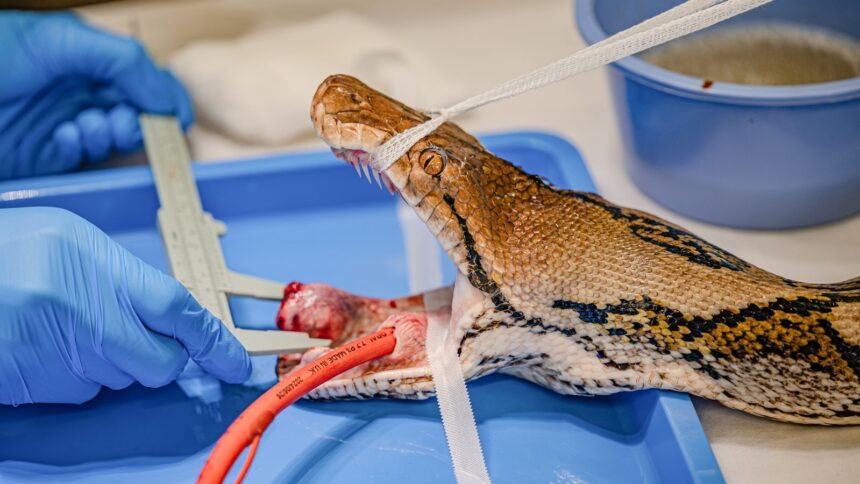
In an improvised treatment, Jodie was anaesthetised in its own habitat before being carried to the zoo’s veterinary centre.
Mr Ashpole said that the python is so big, “we had to put two operating tables together, effectively making one the size of a double bed.”
He then removed the tumorous mass and removed part of Jodie’s diseased jawbone before electrochemotherapy was administered to target any remaining cancerous cells.
The treatment combines the cancer drug bleomycin with a series of carefully controlled electrical pulses delivered directly to the tumour site.
The pulses temporarily make cancer cells more permeable, allowing the drug to enter more effectively, and mean lower doses of chemotherapy can be used – often in a single procedure.
It’s been a success, said Mr Ashpole: “Seeing it back to its normal bright and feisty self has been incredibly rewarding.
“A few months ago, we genuinely didn’t know whether it would survive. Now it’s eating normally, exploring its habitat and behaving exactly as we hoped.”
Despite losing part of its jawbone, Jodie’s appetite and hunting ability have not been affected, the zoo officials said.
A final check confirmed it remains free of any signs of the cancer returning, a spokesperson of the zoo added.