


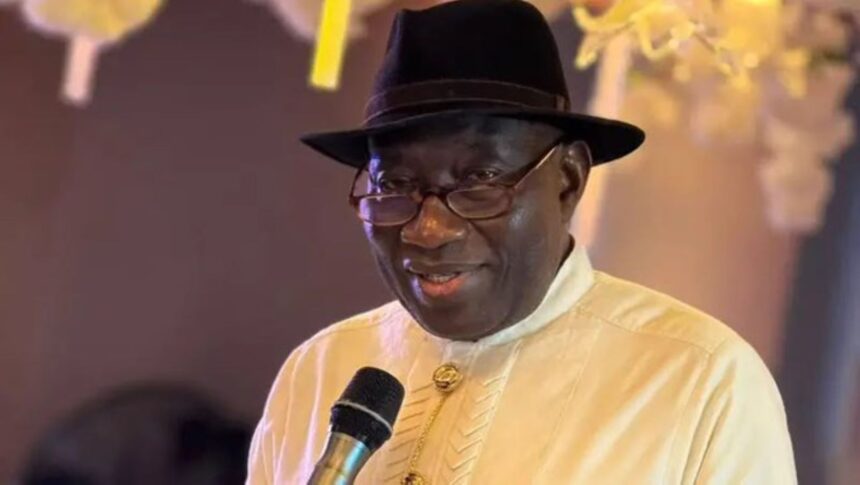
Former President Goodluck Jonathan on Saturday, November 14, x-rayed Nigeria’s politics, calling for far-reaching reforms, political leadership recruitment and education system.
He also warned that the country risks failing to realise the aspirations of its founding nationalists.
Jonathan said Nigeria must move away from religious politics, opaque democratic practices and the recruitment of political leaders based on religious and ethnic considerations if it must achieve sustainable development.
He said these at the maiden Herbert Macaulay Colloquium, organised by the Macaulay Heritage Foundation in partnership with the Lagos State Ministry of Tourism, Arts and Culture, and held at the Nigerian Institute of International Affairs (NIIA), Victoria Island, Lagos.
The event, with the theme: “Nationalism and Nation Building,” was organised to commemorate the 162nd birthday of the foremost nationalist, Herbert Macaulay.
The gathering attracted eminent Nigerians, including former Deputy National Chairman of the Peoples Democratic Party (PDP), Chief Bode George; Chairman of the Governance Advisory Council, Pa Tajudeen Olusi; representatives of the Oba of Lagos, eminent scholars and politicians.
Jonathan said the nationalist’s vision of independence went beyond the transfer of political power from colonial authorities to Nigerians.
He said the founding nationalists envisaged a sovereign country where citizens would determine their destiny, control their resources and deploy them for national development and the welfare of the people.
According to him, they also envisaged a united country where every citizen, irrespective of ethnic, religious or social background, would enjoy equal rights, dignity and opportunities.
However, he questioned the extent to which Nigeria had fulfilled those expectations 66 years after independence.
He said: “Although the country had recorded progress in some areas, challenges such as poor leadership, institutional weaknesses, corruption, policy inconsistency, inadequate infrastructure, insecurity and dependence on raw material exports had continued to undermine national development.”
Earlier, George, the convener of the colloquium, described Macaulay as a special gift to Nigeria whose contributions to the country’s political development deserved greater recognition.
He said the gathering was intended to examine the strategies and methods through which the nationalist challenged British colonial rule and championed the interests of Nigerians.