By Olatunbosun Obafemi
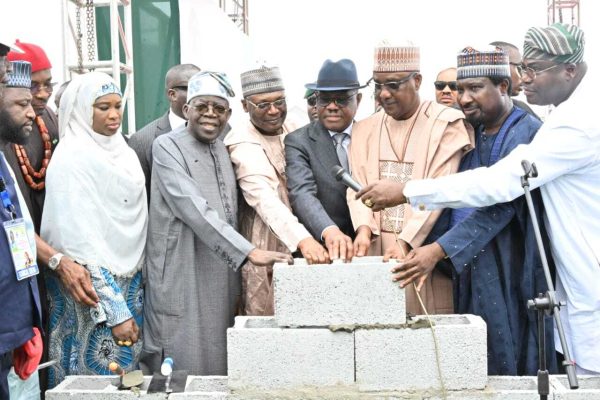
President Bola Ahmed Tinubu on Tuesday presided over the groundbreaking ceremony for the new national headquarters of the Independent National Electoral Commission (INEC) in Abuja, declaring the project a symbol of Nigeria’s democratic resilience and institutional dignity.
Speaking at the event, Tinubu said the construction of the new facility went beyond physical infrastructure, emphasizing its significance for the future of Nigeria’s democracy. “Today’s ceremony is not merely about bricks and mortar. It is about the strength of our democracy, the independence of our institutions, and the future of our electoral integrity,” the President said.
The project, being executed by the Federal Capital Development Authority (FCDA), is based on a concept designed by INEC’s technical department. The new building will feature administrative offices, meeting rooms, a 1,000-seat auditorium, and IT infrastructure including the Election Monitoring and Support Centre. It will also include a museum dedicated to preserving Nigeria’s electoral history and fostering civic education.
President Tinubu stressed that the new headquarters was a clear reflection of his administration’s commitment to INEC’s autonomy and operational capacity. “This new headquarters is a clear signal of our unwavering support for INEC’s autonomy, capacity, and growth,” he said. “Our democracy is still evolving, and as it grows, so too must the institutions that support and protect it.”
Minister of the Federal Capital Territory, Nyesom Wike, assured that the project would be completed before the end of Tinubu’s first term in 2027. Wike’s ministry has been instrumental in pushing the project forward, stepping in last year to resolve what INEC described as a long-standing accommodation crisis.
INEC Chairman, Professor Mahmood Yakubu, described the project as a long-overdue response to the commission’s infrastructural challenges. According to him, INEC has outgrown its current headquarters, which was inaugurated in 1997 and originally designed for just eight commission members, 10 departments, and 500 staff. Today, INEC has 13 full-time commission members, 22 departments, and 1,048 staff — more than double the original capacity.
“Our present national headquarters is severely congested,” Yakubu said, noting that the commission currently rents two additional buildings which remain inadequate. He explained that this is the third time since 1991 that the FCDA has provided accommodation to the electoral body.
President Tinubu praised INEC’s leadership, past and present, for their commitment to electoral integrity under difficult conditions. He urged Nigerians to see democracy as a continuous journey that requires constant nurturing and institutional support.
“As we break ground today, we also lay a stronger foundation for democratic resilience in Nigeria,” Tinubu declared. “Together, let us strengthen our institutions, safeguard our freedoms, and protect the future.”
The ceremony signals a new phase in the federal government’s effort to modernize electoral administration and enhance transparency in Nigeria’s democratic process.