President Bola Tinubu has revealed that Nigeria will spend an estimated $11.6 billion on debt servicing in 2026, warning that the country’s industrial growth is being crippled by what he described as an unfair global financial system that places African economies at a disadvantage.
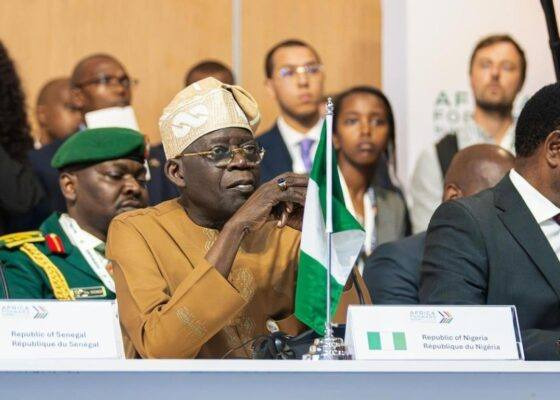
Tinubu made the disclosure on Tuesday while addressing world leaders, diplomats and investors at the Africa Forward Summit held at the Kenyatta International Convention Centre in Nairobi, Kenya.
According to the President, nearly half of Nigeria’s projected revenue for 2026 would go into repaying debts, leaving limited resources for critical sectors such as manufacturing, infrastructure, energy and technology.
“Every single dollar that leaves our treasury to pay punitive interest rates is a dollar that did not go into our steel sector, textile mills, agro-processing plants or digital industries,” Tinubu said.
He lamented that African nations continue to face excessively high borrowing costs compared to countries in Europe, Asia and North America, despite implementing economic reforms and improving fiscal management.
Tinubu argued that the current international financial architecture was “an instrument of industrial disarmament for Africa,” stressing that the continent cannot industrialise effectively under such conditions.

The President maintained that Nigeria was not asking for charity but demanding fair access to affordable financing that would allow African countries process their raw materials locally, refine crude oil, manufacture pharmaceuticals and compete globally.
Highlighting recent economic reforms by his administration, Tinubu said Nigeria had taken “painful but necessary” decisions, including the removal of fuel subsidy, unification of the foreign exchange market, recapitalisation of the banking sector and efforts that helped the country exit the Financial Action Task Force (FATF) grey list.
According to him, the reforms have strengthened investor confidence, improved external reserves to $45.5 billion and reduced Nigeria’s debt-to-GDP ratio, projected at 32.3 per cent in 2026.
The President also used the occasion to push for stronger African economic integration and maritime cooperation, pledging to make Nigeria’s Deep Blue maritime security infrastructure available as a shared intelligence hub for countries in the Gulf of Guinea.
On migration, Tinubu said Africa must address unemployment, poverty and lack of opportunities if it hopes to reduce irregular migration among youths.