

By Ebenezer Mabinuola
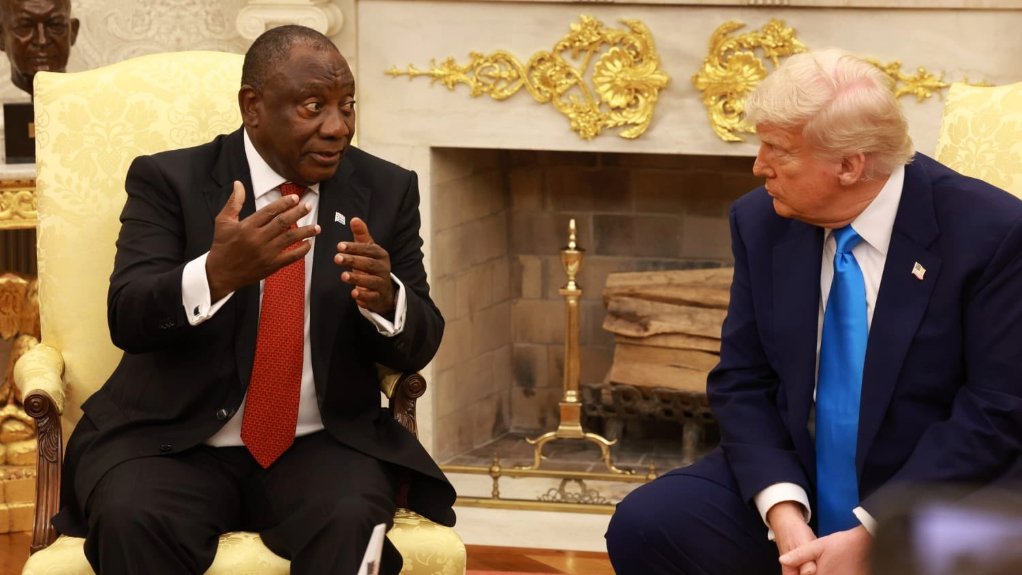
What began as a routine diplomatic encounter exploded into an Oval Office spectacle of global proportions on Wednesday, as U.S. President, Donald Trump turned a closed-door meeting with South African President Cyril Ramaphosa into a high-octane clash over race, crime, and international truth-telling.
In a scene more reminiscent of a political rally than a state meeting, Trump dimmed the lights, summoned a television screen, and hit play on a montage of incendiary footage. With a stunned South African delegation looking on — and tech mogul Elon Musk seated silently at his side – Trump unleashed a barrage of imagery featuring protest chants, blood-spattered headlines, and claims of farm murders. The phrase that sent diplomatic shockwaves: “Kill the Boer, kill the farmer.”
“This is genocide,” Trump declared, slamming down a folder of photographs on the Resolute Desk. “And no one wants to talk about it – but I will.”
The move was anything but spontaneous. According to multiple White House aides, the video presentation had been rehearsed in advance with Trump reportedly requesting custom editing of protest footage and cue cards for dramatic effect.
Ramaphosa, ever the seasoned statesman, maintained his composure in what quickly became one of the most volatile Oval Office encounters in modern diplomatic memory. Rising from his chair slowly, he responded: “Mr. President, South Africa is not a battlefield of races. It is a democracy still healing – but not dying.”
Behind him stood a diverse ensemble: trade union icon Zingiswa Losi, billionaire Johann Rupert, and golfing greats Ernie Els and Retief Goosen — each of whom had been part of a carefully curated “people-to-people” diplomacy team. But none could have predicted this: a verbal fusillade that replaced handshakes with headline warfare.
The presence of Elon Musk, the South African-born billionaire who has recently taken to X (formerly Twitter) to raise concerns about violence in his homeland, added intrigue and intensity. Though he never spoke during the meeting, his gaze remained fixed on the screen as Malema’s chants echoed across the room.
Later, sources close to Musk said he felt “vindicated” by the footage – though critics accused both him and Trump of inflaming an already fragile narrative.
Attempting to steer the conversation back to policy, Ramaphosa invoked the legacy of Nelson Mandela and the principles of reconciliation. “We do not sanitize crime,” he said. “But let us be clear: criminality is our enemy – not race, not heritage, not the past.”
Rupert, stepping forward, delivered what some in the room called the line of the day: “There is no racial war in South Africa. There is a crisis of poverty and governance — and we need partners, not provocateurs.”
Initially scheduled to discuss trade, mineral access, and AGOA renewal, the meeting veered dangerously off track. U.S. officials had hoped to secure South African lithium and rare earths for defense tech. Ramaphosa’s team sought relief from Trump’s punishing 30% tariffs and to cement G20 participation. None of that was resolved.
Instead, Trump repeatedly returned to what he called “the horror in the heartland,” referring to white farmers. “They’re leaving. They’re terrified. And we’re going to protect them,” he said – referencing his administration’s recent executive order granting asylum to nearly 60 white South Africans under an “urgent persecution” clause.
The spectacle has thrown the future of U.S.-South African relations into uncertainty. Diplomats called it “a thunderclap moment,” warning that trust between the two nations may be severely damaged. One senior State Department official, speaking anonymously, said: “This wasn’t a conversation — it was a performance. But the world was watching.”
Ramaphosa, undeterred, delivered a quiet rebuke in a post-meeting statement: “We will never let our national dignity be dictated by foreign misunderstandings.”
As global headlines ignite and both leaders return to their political orbits, analysts are left parsing the meaning of the Oval Office showdown.
“This wasn’t diplomacy – it was spectacle statecraft,” said Dr. Fiona Makgoba, a South African foreign policy expert. “But Ramaphosa held his ground. And sometimes, in the eye of the storm, that’s the only way to win.”
In the coming weeks, attention will turn to whether Trump follows through with threats to cut South Africa from key trade agreements — or whether this was merely a flashpoint in his unpredictable political theatre.
One thing is certain: history was made in the Oval Office this week — not through agreement or accord, but through a confrontation that laid bare the fault lines of modern geopolitics.
And as the world recalibrates, one question lingers:
Was this the start of a new diplomatic cold front — or simply the latest act in the Trump doctrine of disruption?