


By Olatunbosun Obafemi
By the time police operatives arrived at the uncompleted building in Umuojor village, Ezeagu Local Government Area, it was 3:15 a.m. – the hour when darkness still held its grip, and most of the community lay asleep. But what they uncovered that morning would rouse the entire state.
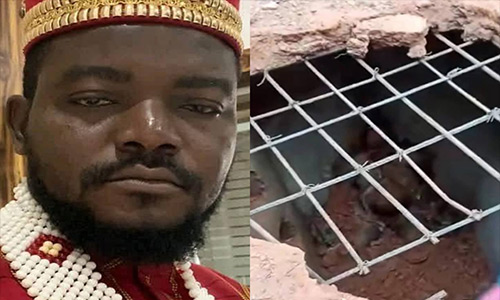
Inside what was supposed to be a shrine – an unassuming structure owned by a popular native doctor known in the area as High Chief Levi Onyeka Obu, alias “Ezeani,” and “As e de play, e dey show” – officers from the Enugu State Police Command, flanked by local vigilantes and members of the Neighbourhood Watch, made a horrific discovery: two decomposing bodies, buried in a pit sealed with concrete. One male. One female. Their deaths, according to early police findings, were the result of ritual killings.
But they weren’t too late. A 13-year-old girl—whose name is being withheld—was found alive. She had allegedly been abducted and held captive, moments away from becoming the shrine’s next victim.
The operation, led by officers from the Umumba Division, resulted in the arrest of three suspects: Uche Kingsley Agumba (33), Ilo Nweze Onyedikachi (36), and Ejike Odinwankpa (38). All are believed to be members of Obu’s ritual gang. But the man at the center of it all—Obu himself—fled the scene and is currently on the run.
In the days that followed, shock rippled through Ezeagu and across Enugu State. The shrine was no ordinary religious structure. It doubled as a hub for alleged criminal enterprise, a space where the sacred and the sinister intersected. Community members who once revered Obu as a powerful spiritual figure are now reckoning with the possibility that they lived alongside a man capable of monstrous acts.
In swift response, the Enugu State Government ordered the demolition of all buildings tied to the fugitive suspect. What remained of the shrine was reduced to rubble, a symbolic gesture meant to erase the physical footprint of evil—but not its memory.
Commissioner of Police, CP Mamman Bitrus Giwa, who personally visited the crime scene, commended the bravery of the rescue team and the vigilance of local residents who tipped off authorities. He has since deployed tactical squads and intelligence units to track Obu and any other accomplices still at large. “There will be no hiding place,” he vowed.
As investigations continue, the questions pile up: How long had the shrine operated as a death trap? How many victims preceded the two found in the pit? And how did a man so deeply embedded in the community manage to carry out such alleged atrocities unnoticed?
For now, Umuojor village is grappling with a terrifying realization—that behind the walls of a shrine cloaked in tradition, a ritual horror had taken root.