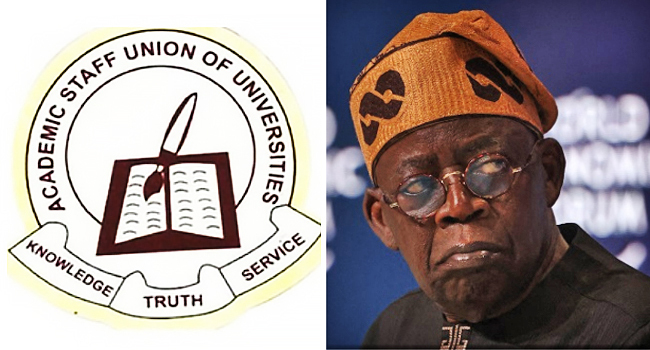
In the past two decades, perhaps no other issue has disrupted Nigeria’s social and economic fabric as consistently as the Academic Staff Union of Universities’ (ASUU) strike. The recurring work stoppages, often lasting months, have crippled academic calendars, shattered the dreams of countless students, and undermined the very essence of higher education in the country. Once again, the union is agitating over unmet promises, withheld entitlements, and a controversial new loan scheme. The nation stands at the edge of yet another avoidable industrial crisis — unless decisive leadership is exercised.
President Bola Ahmed Tinubu, during his electioneering campaign, made a categorical promise: under his administration, there would be no ASUU strike. Nigerians, especially students and parents, embraced that pledge with hope, weary of the long history of government-ASUU clashes. Today, as murmurs of another looming strike gain volume, the President must be reminded that his credibility is on the line. To allow a fresh breakdown of relations between the government and the union would not only betray a solemn promise but also further erode public trust in political assurances.
At the heart of the union’s grievances are familiar issues: unpaid salaries, earned allowances, unimplemented agreements, and the demand for better funding of tertiary institutions. The introduction of the Tertiary Institution Staff Support Fund loan scheme, recently rejected by ASUU, has deepened mistrust. Lecturers argue — and not without merit — that offering them loans while their legitimate earnings are withheld is akin to mocking their sacrifice. They demand entitlements, not debts. How can a government that owes its lecturers salaries and allowances reasonably expect them to embrace borrowing as a solution to their hardship?
The Tinubu administration must understand that this is not simply a labour dispute but a matter that cuts to the core of Nigeria’s future. University education is the foundation upon which human capital is built, and every disruption leaves a scar that is difficult to heal. For every semester lost to strikes, Nigeria loses not just time but competitiveness in an increasingly knowledge-driven world. Young Nigerians are left frustrated, many turning to foreign institutions if they can afford it, or abandoning education altogether if they cannot. The result is a widening skills gap, brain drain, and the entrenchment of mediocrity.
Avoiding another strike requires a combination of sincerity, urgency, and innovation. First, the government must prioritise honouring existing agreements. The 2009 FG-ASUU agreement, often cited but rarely implemented, has become a recurring sore point. The administration should initiate an open and time-bound renegotiation, bringing both parties to the table with verifiable timelines for implementation. A situation where agreements are signed merely as instruments of convenience, without the intention of honouring them, is both deceptive and destructive.
Second, there must be a sincere commitment to addressing the welfare of university lecturers. Competitive salaries, prompt payment of allowances, and improved working conditions are not luxuries but necessities if Nigeria is serious about retaining talent in its universities. Many Nigerian lecturers, trained at great cost, are migrating to institutions abroad where they are better valued. Without urgent reforms, Nigeria risks hollowing out its academic system.
Third, sustainable funding for universities must be institutionalised. For too long, Nigeria’s universities have depended almost solely on government subventions that are inadequate, irregular, and politically manipulated. While TETFund has provided some relief, it is not enough. The federal government must establish a transparent higher education funding framework, encouraging private sector participation, alumni endowments, and innovative financing models that reduce over-reliance on Abuja’s purse strings. What Nigeria spends on education today is not an expenditure but an investment in national survival.
The President also needs to rethink the communication gap that often characterises government-union relations. Too often, ASUU leaders complain of being ignored, dismissed, or invited to fruitless meetings. A culture of genuine dialogue must replace confrontation. Even in disagreement, mutual respect and good faith can go a long way toward building trust.
President Tinubu should see this moment as an opportunity to demonstrate a break from the past. His administration has already asked Nigerians to endure painful reforms in fuel subsidy removal and exchange rate liberalisation, with the promise of long-term benefits. For that social contract to hold, government must also demonstrate seriousness in areas that directly affect citizens’ lives, such as education. What greater signal of leadership can he give than ensuring uninterrupted academic calendars, where young Nigerians can study, graduate on time, and contribute to nation-building?
Averting another ASUU strike is not just about appeasing lecturers; it is about safeguarding Nigeria’s future. The country cannot continue to treat its universities as afterthoughts while paying lip service to economic transformation. No nation has ever developed without a strong, stable, and respected education system.
Mr. President, the time to act is now. Honour your word to the Nigerian people. Prevent another strike not through threats or half-measures but by addressing the core grievances of our universities. The cost of failure will not be borne by ASUU or the government alone but by millions of young Nigerians whose futures are already too fragile.
The nation waits.