By Ebenezer Mabinuola
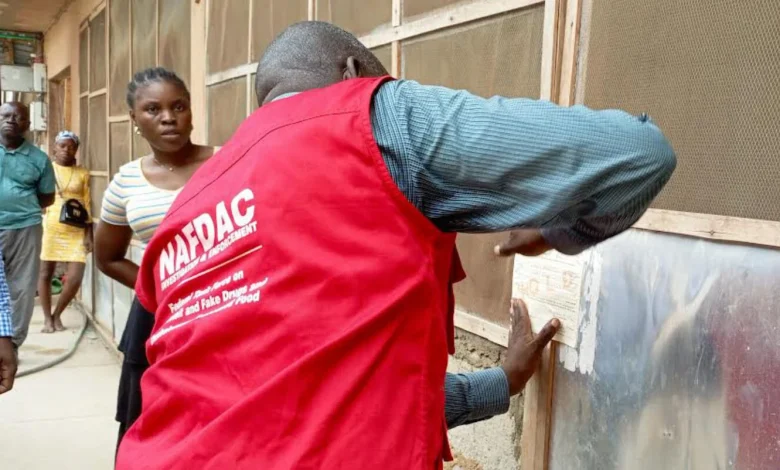
The National Agency for Food and Drug Administration and Control (NAFDAC) has denied reports that Nigeria’s major pharmaceutical markets, including the Ogbo Ogwu Drug Market at the Bridgehead in Onitsha, have been fully reopened without conditions.
In a statement released on May 30, 2025, the agency described such claims as “false and misleading,” reiterating its commitment to sanitizing the nation’s pharmaceutical supply chain.
At the center of the dispute is ongoing confusion – and, in some cases, deliberate misinformation – surrounding NAFDAC’s recent enforcement actions aimed at curbing the distribution of counterfeit, expired, and unregistered drugs.
According to the agency, reopening these markets is not automatic. Rather, it is contingent upon traders meeting stringent administrative and regulatory requirements. These include submitting full documentation, signing legally binding undertakings, and paying penalties for prior infractions.
Originally, NAFDAC had imposed a N5 million charge for the sale of unregistered products and N2 million for poor storage conditions. However, following appeals from pharmaceutical market associations, these charges were reduced to N200,000 and N500,000 respectively. The agency has maintained that these fees are not punitive, but necessary deterrents against long-standing violations in Nigeria’s drug markets.
“These sanctions are legal and essential for restoring regulatory order,” said NAFDAC Director-General, Professor Mojisola Adeyeye. “Reopening without reform would be akin to pouring clean water into a poisoned well.”
From February 9 to March 27, NAFDAC conducted sweeping operations across drug distribution hubs in Onitsha, Lagos (Idumota), and Aba (Ariaria), seizing counterfeit and substandard medicines valued at over N1 trillion. The scale of the violations – including the operation of unauthorized shops and the illicit sale of narcotics – prompted a blanket market shutdown.
Public response to the crackdown has been mixed. While many public health advocates have welcomed the agency’s action, civil rights groups and market associations have accused NAFDAC of overreach and extortion.
In Onitsha, members of the Concerned Genuine Members of Ogbo Ogwu Drug Market have staged protests, alleging that at least five traders have died as a result of stress and financial hardship linked to the prolonged closure. They further accused the agency of demanding N2 million per shop to resume business – an allegation NAFDAC categorically denies.
Political leaders have also weighed in. Former Anambra State Governor Peter Obi and Senator Tony Nwoye have both criticized the agency’s enforcement strategy. Obi called for “a more humane, structured approach that doesn’t destroy livelihoods in the name of reform,” while Nwoye urged deeper collaboration with local stakeholders to build a sustainable and safer pharmaceutical ecosystem.
The pushback has highlighted a broader national dilemma: how to balance economic survival with public health enforcement in a country where regulatory oversight has historically been uneven.
In response, Professor Adeyeye reaffirmed that the agency’s focus is not on punishing legitimate business owners, but on preventing the public health risks posed by unsafe drugs.
“Our mandate is clear: to protect Nigerian lives,” she said. “We cannot afford to compromise public safety for the sake of convenience.”
While the controversy continues to stir debate, NAFDAC insists that reforms are non-negotiable. For the agency, the long-term goal is to create a pharmaceutical sector that meets global standards – where every drug on the shelf is registered, stored correctly, and safe for public use.