

By Nchetachi Chukwuajah with Agency Report
Traders at the Onitsha Market in Anambra State have reportedly protested the one-week closure of the market by Governor Chukwuma Soludo.
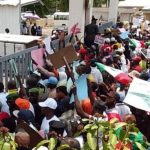
In videos circulating on social media, especially X and Facebook, on Tuesday, January 27, traders flooded the market premises with placards, chanting solidarity songs and expressing support for the detained leader of the Indigenous People of Biafra (IPOB), Nnamdi Kanu.
The Onitsha Main Market was barricaded by security agencies enforcing the one-week closure, as hundreds of security personnel were seen moving around the area early Tuesday morning.
Ssecurity vehicles, including Armoured Personnel Carriers (APC) and Hillux vans, were used to block strategic locations across the market.
Recall that Soludo, during an on-site inspection of the market on Monday, January 26, ordered the closure after traders and market leadership refused to open for business in observance of the Monday sit-at-home order, ignoring repeated government appeals to resume normal economic activity on Mondays.
The state government also revealed that the persistent Monday sit-at-home costs Anambra approximately N8 billion weekly, contributing to a regional loss of N19.6 billion in the South-East.
Some of the protesting traders who spoke with the News Agency of Nigeria (NAN) called for adequate security measures to enable them to adhere strictly to the governor’s directive on the Monday sit-at-home.
According to them, the closure of the market was overbearing and undemocratic, adding that the action was insensitive to the concerns of traders and residents, as adequate security was yet to be achieved in the state.
They also questioned whether the government could restore the lives of those who might lose their lives in the process of returning to business.
A trader, Mr Ugochukwu Okigbo, described the Soludo-led administration’s action as insensitive, saying adequate security had not yet been achieved in the state.
Okigbo alleged that traders had, in the past, tried to comply with government directives to end the sit-at-home menace but were killed in the process, without the government being able to reverse the losses.
Okigbo said a one-week total closure of a major market like Onitsha Main Market amounted to government insensitivity to traders’ fears.
Another trader, Mr Daniel Nwachukwu, said the week-long closure would inflict far-reaching economic damage compared to the once-a-week Monday sit-at-home observed by traders for their safety.
Mrs Chikaodi Eze said the Monday sit-at-home disrupts economic activity for a single day, while a full-week shutdown collapses supply chains, wipes out weekly turnover, and accelerates spoilage of perishable goods.
Eze said the government’s declaration would also trigger layoffs and deepen liquidity crises for small traders who survive on daily sales.
Mr Ekene Nwankwo said the government had misfired, noting that markets are not operated like light switches that can be turned off and on without cost.
Nwankwo said the ripple effects of a week-long closure extend beyond traders to transporters, artisans, consumers, and even the state’s revenue base.
Mr Mmezi Ofo said traders were more troubled than the government because their businesses are capital-intensive and require daily operations to avoid losses.
A community leader, Chief Okwudili Ogbonna, said there was no law empowering the government to compel traders to open their shops, describing the action as an abuse of power.
Ogbonna said in a free-enterprise society, government cannot arbitrarily dictate when traders open their businesses, adding that traders are free to decide how and when to conduct their enterprises.
“This freedom flows from constitutionally guaranteed rights to property, occupation, and movement.
“The limited power government may exercise is regulatory, such as prescribing general market hours purely for order, safety, and administration,” he said.
Mr Jude Atupuliazi recalled that traders’ absence from many markets in Anambra on Mondays followed violent enforcement by non-state actors who claim to be members of the proscribed Indigenous People of Biafra (IPOB).
He said the sit-at-home directive had led to killings of defaulters and the destruction of shops, vehicles, and other property.
He urged the government to refrain from issuing forceful orders, adding that normalcy would return gradually.