By Desire Emmanuel
Many of us in our younger years folded some papers and made planes with them which we threw in the air and they landed after three to five seconds.
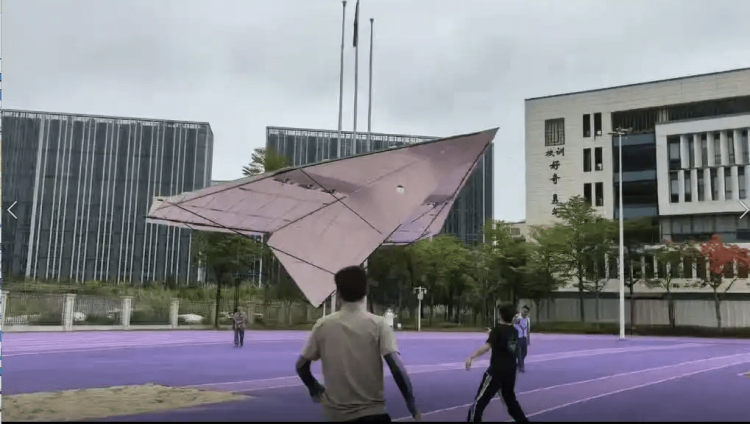
However, a team of secondary school students in China recently set a new Guinness World Record after they created the world’s largest remote-controlled paper plane that was in the air for about 15 minutes, the country’s media reported.
The students from the Shenzhen Zhili Middle School, led by Zhu Junjie, spent almost six months putting together the gigantic yet perfectly functional paper plane.
Featuring a wingspan of 6.06 metres and a fuselage length of 5.06 metres, the world’s largest paper plane was successfully tested earlier this month, staying in the air for about 15 minutes before landing on the ground.
“We just wanted to use the most basic paper airplane principles, combined with engineering technology, to create a stable, extra-large model,” Zhu Junjie, the project’s chief designer and pilot, told the media about the motivation.
It was gathered that last October, Zhu and his team had won a championship in the country and broke the national record at the China International Aircraft Design Challenge, which gave them the confidence to tackle an even bigger project, such as setting a new Guinness World Record.
After researching and confirming that the six-metre paper plane was yet unattained in the field of unmanned remote-controlled paper airplanes at the time, they set a new goal for themselves – to create “the largest remote-controlled paper airplane to date!”“The biggest challenge of this project is precisely its ‘extra-large’ nature,” Zou Guoyun, the instructor of the school’s model aircraft club, told reporters, adding that in ultra-large aircraft, every one-degree adjustment of the wing surface and every one-centimetre shift in the centre of gravity directly affects lift and stability.
Although the core team members have an average age of 16, they overcame engineering challenges that could be considered difficult even for adult professionals in the field of aeronautics.
In terms of materials, they chose lightweight KT board as the main material, but despite its advantage, it also meant that the larger the area it covered, the more obvious the deformation.
The team innovatively introduced carbon fibre strips to reinforce key parts, finding a delicate balance between “lightweight” and “high strength.”
In terms of design, they abandoned the initial idea of simply scaling up a standard one-metre model to a 1:6 scale. After three generations of model iterations, they finally determined a layout with a fuselage length of over five metres and a wingspan of over six metres to reduce the difficulty of operation.
“We want this project to become a symbol of scientific and technological innovation for Chinese youth, showcasing our wisdom and independent innovation capabilities to the world,” Zhu Junjie said about the team’s achievement.