


By Nchetachi Chukwuajah
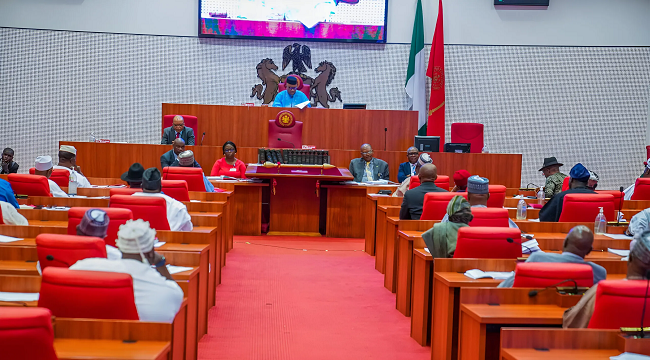
The Senate has said the passage of the Constitution of the Federal Republic of Nigeria (Alteration) (State Police) Bill, 2026, which provides for the creation of state police, is driven by national consensus and the country’s security needs rather than political considerations.
The Senate stated this in a statement issued on Sunday, June 28, by the Directorate of Media and Public Affairs, Office of the Senate Leader, Senator Opeyemi Bamidele.
The Red Chamber’s clarification follows the divergent opinions that have trailed the bill since its passage by the National Assembly on Wednesday, June 24, after more than two-thirds of senators voted in support.
While many stakeholder, including speakers of the 36 state Houses of Assembly, have welcomed the bill’s passage, some groups and individuals, such as Peter Obi, the presidential candidate of the Nigeria Democratic Congress (NDC), have raised concerns about the bill.
Key among the concerns of critics is that the bill’s implementation could worsen insecurity and lead to abuse of state police by governors.
In its statement on Sunday, the Senate described the bill as “a child of necessity and not of political expediency as well as a product of national consensus and not of cynicism.”
According to the Senate Leader, the proposal to establish state police was a matter of urgent public importance that could not be delayed because of political interests, given the country’s security challenges.
He explained that the proposal was not a recent one but emerged from memoranda submitted to the Senate Ad-hoc Committee on the Review of the 1999 Constitution.
According to him, the proposal underwent extensive consultations and rigorous scrutiny because of its sensitive nature.
Bamidele said the National Assembly consulted widely with the Executive, the Nigeria Governors’ Forum, the Conference of Speakers of State Legislatures of Nigeria, the leadership of the Nigeria Police and other stakeholders before passing the bill.
He added that during the public hearings conducted across the six geopolitical zones in July 2025, participants overwhelmingly supported the creation of state police.
“At each level of our consultation, nearly all stakeholders embraced the State Police Bill in the light of stark realities we are facing today,” he said.
The Senate leader noted that recommendations from the Nigeria Police contributed to the bill, particularly on accountability and oversight mechanisms aimed at preventing abuse of state police by political actors.
According to him, the police’s support for the proposal underscores its national significance in tackling insecurity at the state and local levels.
Bamidele also said the bill was overwhelming supported by lawmakers across party lines in both chambers of the National Assembly.
“Even though the APC is the majority, there are members of opposition parties — PDP, ADC, NDC and Labour Party — that exercised their discretion in favour of the Bill, mainly in the national interest and not on parochial basis.
“In the Senate, for instance, 84 out of 109 members voted clause by clause in support of the Bill. This accounted for 77.06 percent approval at the Senate alone,” he said.
He argued that national security should transcend political affiliations, saying political actors in other countries often set aside partisan interests to support initiatives that strengthen security.
Bamidele called on opposition parties to contribute constructive ideas that would promote peace and stability, adding that they have a responsibility to offer alternatives that would strengthen the country.
“Even when they disagree on some grounds, they are under obligations to provide credible and useful ideas that can make our nation better and greater. Unfortunately, they have not passed this critical test of opposition democracy,” he said.