


By Olatunbosun Obafemi
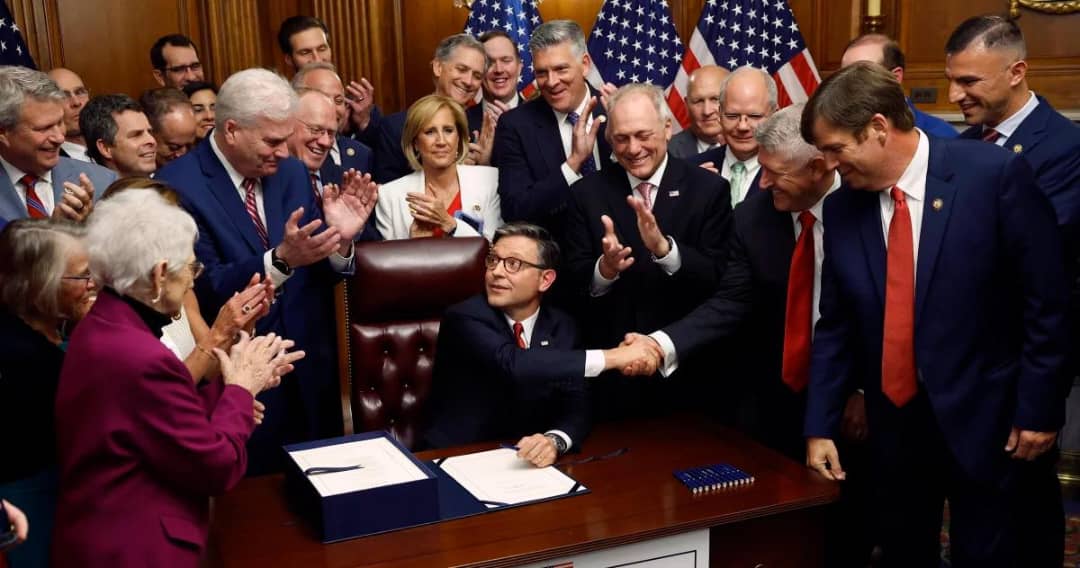
In a narrow vote of 218 to 214, United States House Republicans on Thursday passed a sweeping $3.4 trillion tax and spending bill, sending it to President Donald Trump’s desk for signature just ahead of the GOP’s self-imposed July 4 deadline.
The legislation represents a major realignment of federal priorities, cutting deeply into Medicaid and social safety programs to fund permanent tax cuts, military expansion, and stricter immigration enforcement.
All House Democrats opposed the bill, joined by two Republican defectors – Reps. Thomas Massie (Ky.) and Brian Fitzpatrick (Pa.). The razor-thin margin followed a night of intense lobbying from House GOP leaders and Trump himself, who hosted lawmakers at the White House and took to social media to pressure holdouts.
A Costly “Cornerstone”
House Speaker Mike Johnson (R-La.) hailed the bill as a historic achievement that would usher in “America’s new golden age.” At nearly 1,000 pages, the legislation fulfills key campaign promises by Trump, including making his 2017 tax cuts permanent. However, the nonpartisan Congressional Budget Office (CBO) projects the bill will balloon the federal deficit by $3.4 trillion over the next decade.
The bill also includes controversial Medicaid reforms, including stricter work requirements and funding cuts that the CBO warns could cause nearly 12 million Americans to lose health coverage. Republicans argue the reforms target “waste, fraud and abuse,” while Democrats condemned the cuts as cruel and shortsighted.
Jeffries Sets Record with Fiery Rebuke
House Minority Leader Hakeem Jeffries (D-N.Y.) delivered a marathon 8-hour, 44-minute speech denouncing the legislation as “an immoral document,” breaking the record for the longest floor speech in House history. Reading letters from constituents who rely on Medicaid, Jeffries warned the bill would devastate children, seniors, and people with disabilities.
“This is a direct assault on the most vulnerable Americans,” Jeffries declared.
Party Tensions and Backroom Deals
The bill’s passage came only after behind-the-scenes negotiations with conservative Republicans, many of whom initially objected to the scope of government spending and Medicaid cuts. Trump played a pivotal role in flipping votes, threatening to back primary challengers to dissenters.
However, Speaker Johnson offered few specifics when asked if Trump had made any executive promises to appease skeptical conservatives, saying only that members gained a better understanding of how the bill would be implemented.
Johnson added that more legislative packages would follow in the fall and spring to address unresolved issues.