

By Reuters News Agency
Health officials across Africa are racing to determine how Nigeria’s first Ebola patient in more than a decade became infected, amid fears the outbreak could spread further after reaching a fourth African country.
The Swiss government said on Friday the patient in Nigeria, the Ugandan-born wife of a Swiss diplomat based in Abuja, had not travelled to the Democratic Republic of Congo, where the outbreak was first detected in mid-May before spreading to Uganda, Kenya and now Nigeria.
The Swiss Federal Department of Foreign Affairs said the woman was believed to have contracted Ebola while travelling with her husband in Uganda, which the World Health Organisation declared Ebola-free in August.
The outbreak has now been reported in four countries across eastern, central and western Africa, giving it the widest geographic spread of any Ebola outbreak on the continent to date.
The possibility that the Nigerian patient became infected in Uganda, where officials say she spent a two-week holiday before returning to Abuja, has fuelled concerns about undetected transmission in a country where the outbreak had appeared to be under control.
Ugandan authorities have said the woman had been in eastern Democratic Republic of Congo before transiting through Uganda, but both the WHO and Africa Centres for Disease Control and Infection said that information has yet to be confirmed.
The WHO said investigations were continuing to establish the source of the infection. Nigerian authorities tested the woman for Ebola 13 days after she fell ill in Abuja.
Nigeria and Kenya cases left Uganda on same day
One theory under investigation is that the Nigerian patient may have contracted the virus from Kenya’s first confirmed Ebola patient, who also flew from Uganda’s Entebbe airport on the same day in early October.
The Kenyan patient died two days later in a Nairobi hospital.
Experts have cautioned against drawing firm conclusions, saying that Ebola is spread through direct contact with infected bodily fluids or contaminated objects.
“I think that is very speculative unless there is evidence of sharing the same space in a manner that could explain that,” said Marion Koopmans, a Dutch virologist and member of the WHO’s Ebola emergency committee.
“Random presence at the same location, a large airport, is not a supported epidemiological link by any standard of what we currently know,” Koopmans added.
The WHO’s Kenya representative, Neema Rusibamayila Kimambo, said it could be coincidental that the two patients left Entebbe airport on October 3.
“Among the contacts that we even have here in the country, even all those who are on the plane with this (Kenyan) patient and all airport staff, we have not had any infections in that group,” said Kimambo.
Uganda has not reported Ebola cases since June
Uganda reported 20 Ebola cases in May and June, most of them imported from Congo, but has not detected a case since June.
Ugandan government spokesperson, Alan Kasujja, told Reuters on Thursday that Uganda had no Ebola cases and would make any such information public. He could not be reached for comment on Friday.
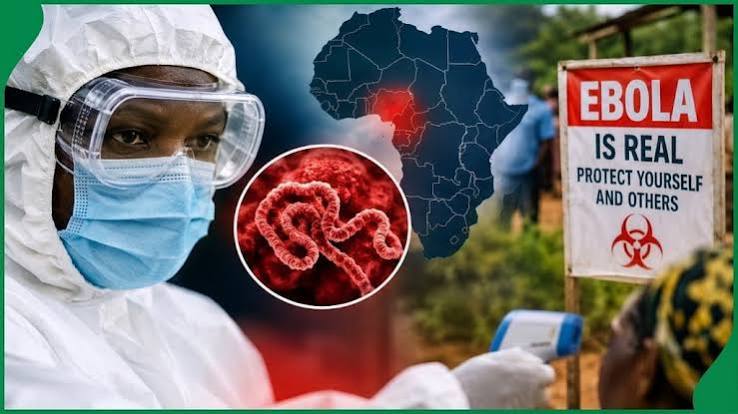
Ebola has infected nearly 10,000 people and killed more than 4,600 in Congo. The disease can cause fever, vomiting, diarrhoea and, in severe cases, internal and external bleeding. Only people with symptoms can transmit the virus.
The rare Ebola species behind the current outbreak has no approved treatment or vaccine.
It will be recalled that Nigeria reported its first Ebola case in more than a decade on Tuesday, becoming the fourth African country and the most populous yet to be affected by an outbreak that health officials have described as the fastest-spreading on record.
The Ebola species behind the outbreak kills about half of those infected and has no approved treatment or vaccine. Since the first cases were confirmed in Democratic Republic of Congo in May, the disease has killed 4,646 people. Health officials fear misinformation and funding shortfalls could fuel further spread within the region and across borders.
Cases have also been reported in Uganda and, more recently, Kenya. “Ebola is now affecting three regions of Africa. The situation demands urgent action and political leadership at the highest level,” Africa Centres for Disease Control and Prevention Director General Jean Kaseya said on X on Wednesday.